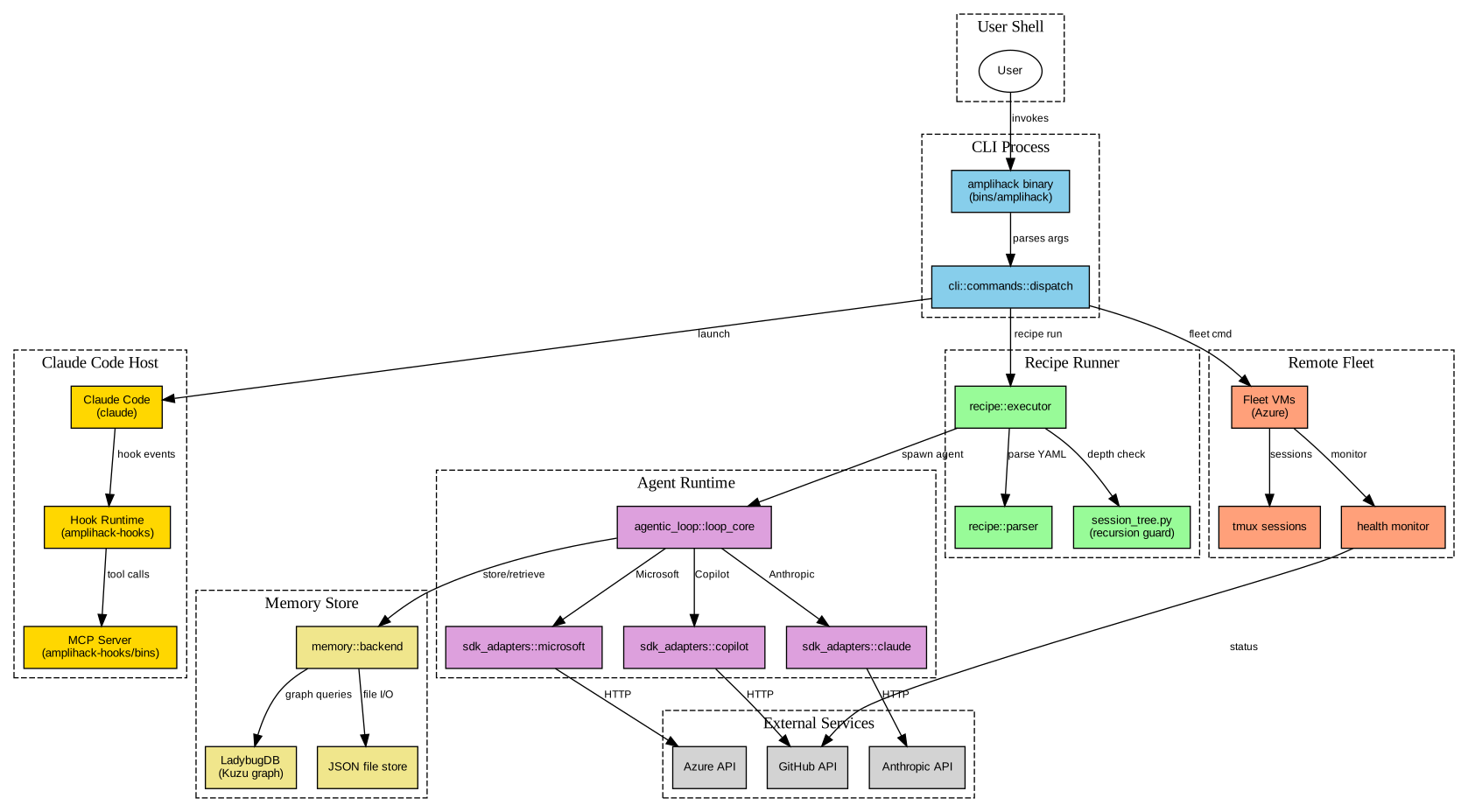
Layer: runtime-topology
amplihack-rs is a CLI toolchain, not a networked service mesh. It ships 3 executables:
amplihack— main CLI (install, recipe run, orchestration, hooks staging)amplihack-asset-resolver-bin— asset resolver helperamplihack-hooks-bin— hooks executable (PreToolUse/PostToolUse, etc.)
These are invoked by the Copilot/Claude launcher and by the recipe runner as subprocesses. There are no long-lived listening services in the workspace.
Recursion and concurrency control
A recipe step can launch an agent, and that agent can launch another recipe. Left
unbounded, that fans out: on one 251 GiB host it exhausted memory four times. The
native recursion guard lives in crates/amplihack-cli/src/commands/session_tree/
and bounds the fan-out along three independent axes.
| control | env var | default | what it bounds |
|---|---|---|---|
| depth | AMPLIHACK_MAX_DEPTH |
3 | how many times a session may nest |
| width | AMPLIHACK_MAX_SESSIONS |
10 | concurrent sessions in one tree |
| memory floor | AMPLIHACK_MIN_AVAILABLE_MIB |
4096 | refuses to admit a session when MemAvailable is below this; 0 disables |
Each subprocess inherits AMPLIHACK_TREE_ID, AMPLIHACK_SESSION_DEPTH and
AMPLIHACK_MAX_DEPTH. Tree state is a JSON file per tree under
$HOME/.amplihack/amplihack-session-trees/. Admission and release are serialised
by two layers: an in-process mutex, because POSIX file locks are per-process
rather than per-thread, and a cross-process exclusive lock on a sidecar file.
The depth ceiling is sealed into the tree at first registration. The
environment may lower it but never raise it, and both the sealed and
environment values are clamped to a hard ceiling of 32, so a forged value cannot
disable the limit. This exists because agents treated a depth refusal as an
infrastructure fault and re-ran with a larger AMPLIHACK_MAX_DEPTH — the
observed escalation was 5 → 6 → 7 → 8 → 9.
The three controls are deliberately different in kind. The memory floor is a capacity check evaluated against the machine's actual state at admission time, so it adapts to the host. Depth is a fixed integer because it is a structural invariant rather than a resource question: it is what stops unbounded recursion when every other signal still looks healthy. Width is the one that is a plain number today; bounding it by observed capacity rather than a constant would suit it better, since 10 is simultaneously too many for a laptop and too few for a 64-core host.
This is not a security boundary. Any process running as the same user can edit the tree state directly. It bounds accidental fan-out, not a hostile one.